
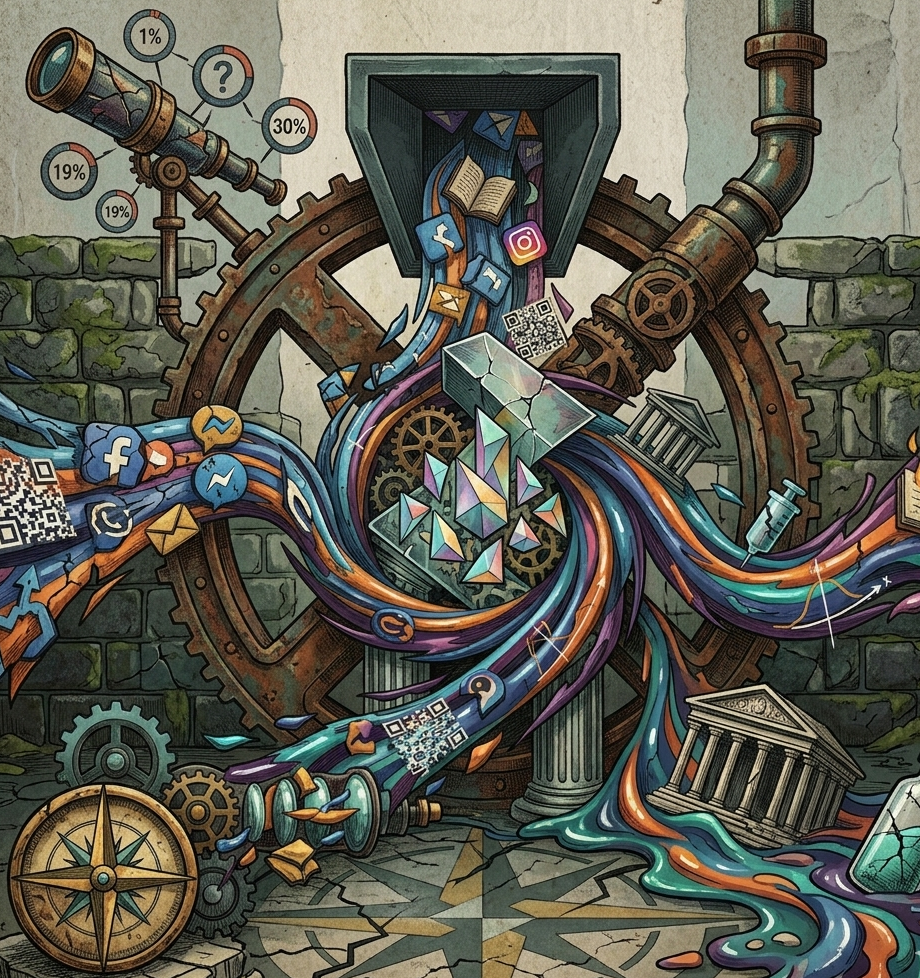
The erosion of a shared reality
The European Commission’s Joint Research Centre report Fractured Reality: How Democracy Can Win the Global Struggle Over the Information Space identifies the breakdown of a shared understanding of reality as one of the most pressing challenges for contemporary democracies. Digital platforms have transformed the way information is produced, distributed, and consumed, enabling increasingly personalised and fragmented narratives.
This fragmentation is not merely a byproduct of technological innovation. It is structurally embedded in the design of the digital information environment, where algorithms prioritise engagement and emotional resonance over accuracy. As a result, citizens are exposed to divergent versions of reality, making collective deliberation more difficult and undermining trust in institutions.
The report suggests that this condition, described as a “fractured reality”, risks weakening the epistemic foundations on which democratic systems depend.
The attention economy and its unintended consequences
A central driver of this phenomenon is the attention economy. The report highlights how dominant platform business models rely on capturing and monetising user attention, creating incentives that favour sensational and polarising content.
In this context, misinformation and disinformation are not anomalies, but systemic outcomes. Content that triggers strong emotional reactions tends to circulate more widely, regardless of its accuracy. Over time, this dynamic contributes to the amplification of extreme views and the marginalisation of nuanced perspectives.
From a digital sustainability standpoint, this raises fundamental questions about the long term viability of current information ecosystems. A system optimised for engagement may generate economic value, but at the cost of social cohesion and informed public discourse.
Artificial intelligence and the scaling of disinformation
The report places particular emphasis on the role of artificial intelligence in reshaping the information landscape. Generative AI technologies make it possible to produce highly convincing content at scale, significantly lowering the barriers to manipulation.
This development accelerates existing trends. Disinformation can now be generated more quickly, tailored to specific audiences, and disseminated across multiple channels with minimal cost. However, the report moves beyond the notion of disinformation by introducing an increasingly relevant cognitive trap, referred to as “epistemia“, i. e. the illusion of knowledge created by an LLM’s fluent language. This concept describes a condition that “may foster a false sense of competence in users, who weave LLM outputs into their reasoning without noticing that the substance is hollow”.
In such an environment, the problem is no longer limited to the presence of misleading content, but extends to the collapse of commonly accepted standards of evidence and verification. The report warns that this may lead to a situation where multiple, incompatible realities coexist, making consensus and democratic deliberation increasingly difficult.
Such conditions not only challenge individual users, but also strain institutional mechanisms designed to ensure information integrity.
A global struggle over the information space
Beyond its technological dimension, the report frames the information space as an arena of geopolitical competition. States and non state actors seek to influence narratives, shape public opinion, and gain strategic advantages through information operations.
In this global struggle, Europe faces specific vulnerabilities. Its open information environment, while a cornerstone of democratic values, can be exploited by actors aiming to destabilise public discourse. At the same time, the dominance of non European platforms raises concerns about control, accountability, and alignment with European norms.
The report therefore calls for a more assertive approach to protecting the integrity of the information space, combining internal resilience with external strategic awareness.
Rebuilding democratic resilience
Addressing these challenges requires a comprehensive and coordinated response. The report outlines a range of policy directions, including stronger regulation of digital platforms, support for independent media, and investments in digital literacy.
However, the emphasis is not only on mitigation, but also on transformation. The goal is to create an information ecosystem that supports democratic values, fosters trust, and enables meaningful participation. This involves rethinking the incentives that shape digital environments and exploring alternative models of platform governance.
Importantly, the report highlights the role of citizens, institutions, and private actors in co creating a more resilient information space.
Digital sustainability as an information challenge
From the perspective of digital sustainability, the insights of Fractured Reality: How Democracy Can Win the Global Struggle Over the Information Space are particularly significant. They suggest that sustainability must be understood not only in environmental or economic terms, but also as the capacity of information systems to support long term societal wellbeing.
A sustainable digital ecosystem is one in which information is reliable, accessible, and conducive to informed decision making. It is an environment where technological innovation aligns with democratic principles, rather than undermining them.
The report makes clear that achieving this vision will require systemic change. In an era defined by information abundance and cognitive scarcity, the future of democracy depends on the ability to redesign the digital infrastructures that shape how reality itself is constructed and shared.
Full Report:
jrc.ec.europa.eu